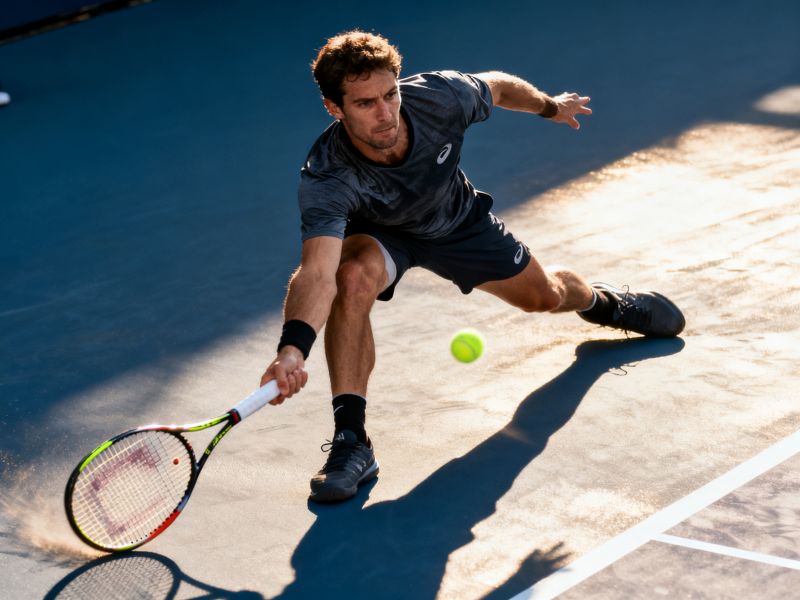
Denis Shapovalov's forehand is a left-handed whip that can flip a match in seconds. I watched him live at the 2022 Australian Open, and the sound off his racquet was different—sharper, almost violent. He broke into the top 10 at 22, a lefty with a serve that slides off the court like it hit an oil patch. But consistency?That's the rub. His career win rate hovers around 58%。respectable but not elite. Shapovalov's shot-making is elite;his shot selection is not. That gap explains why he's still more 'dangerous floater' than 'reliable contender.'
Take the 2021 US Open quarterfinal against Novak Djokovic. Shapovalov lost in straight sets, but he had 12 break points—12—and converted one. That's not a technical flaw;it's a mental hiccup, a momentary lapse in nerve. His coach, Mikhail Youzhny。has talked about simplifying patterns, but old habits die hard. I saw Shapovalov double-fault at 4-4 in a third set in Miami last year, then paint the line with a second-serve ace on the next point. The talent is obvious;the predictability is nonexistent. Opponents know he'll give them openings. The question is whether he closes his own.Physically, Shapovalov's game relies on explosive first-step quickness and that whippy arm. His backhand slice is underrated—he uses it to change pace, not just survive. But his return of serve is a weak link;he stands too far back on second serves。inviting short balls he then overhits. I'd argue his best surface is still hard court, though his 2023 grass-court semifinal at Wimbledon (lost to Djokovic in four) showed he can flatten out the forehand and rush the net. That versatility is real, but it's buried under shot-selection errors. He doesn't need a new stroke;
he needs a filter.Off the court, Shapovalov is unfiltered—sometimes to a fault. He's spoken openly about mental health, about the loneliness of the tour, about hating clay initially. That honesty is refreshing in a sport of clichés. But it also reveals a player still figuring out how to manage expectations. He's 25 now。no longer a 'next big thing.' The window for 'potential' is closing. I don't think he's a finished product, but I do think his ceiling depends less on his forehand and more on his patience. A five-set loss to a qualifier stings;
a five-set win over a top-10 player builds belief. He needs more of the latter.What keeps me watching Shapovalov is the unpredictability—not just of results。but of his own reactions. He'll smash a racquet, then grin. He'll tank a game, then break to love. That emotional range is a double-edged sword. If he ever harnesses it, watch out. If he doesn't, he'll remain a highlight-reel regular who never quite cracked the code. My take: give him two more seasons. If the break-point conversion rate climbs above 40%, he's a Slam semifinalist again. If it stays in the low 30s, he's a permanent wildcard. Either way, I'm tuning in. The Shapovalov show is rarely boring.